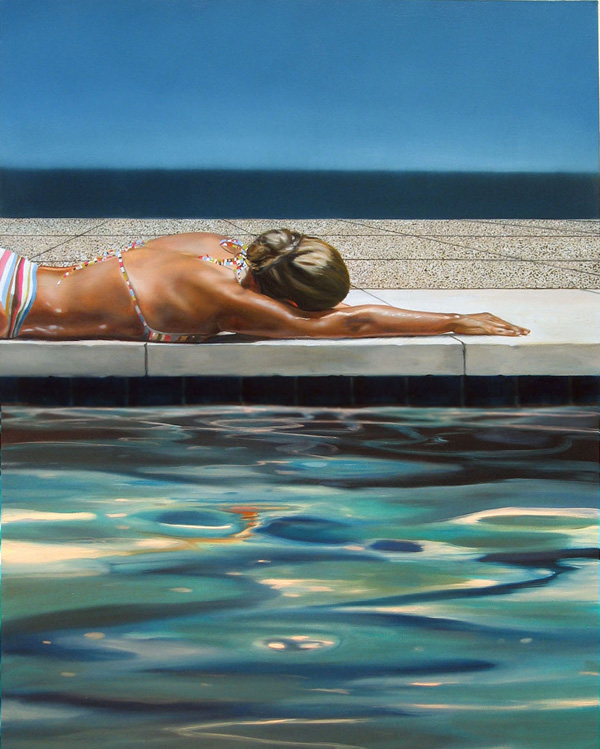
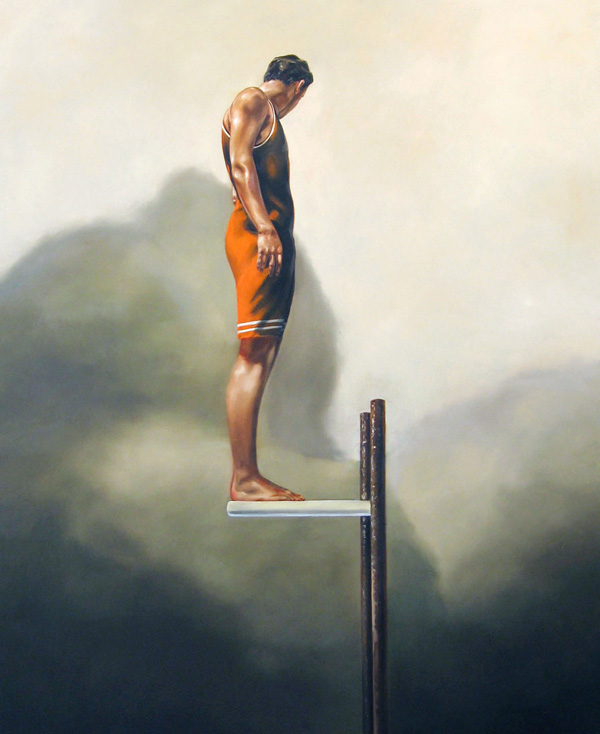
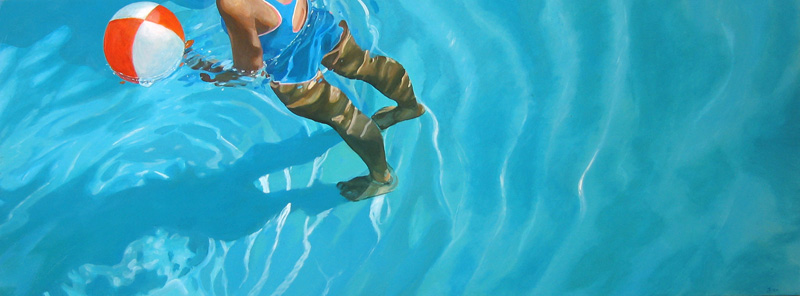
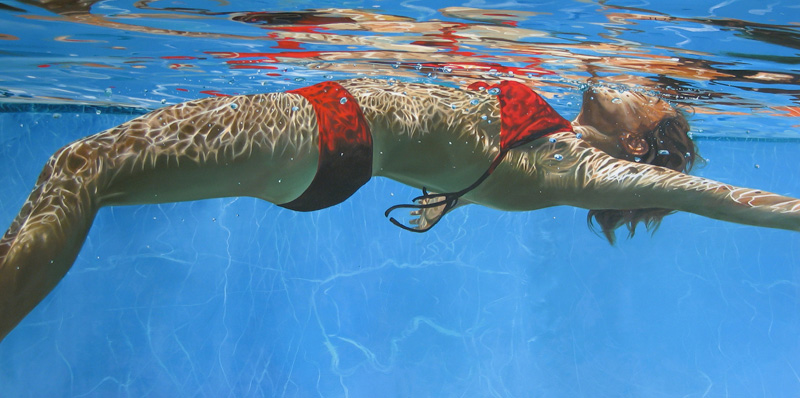
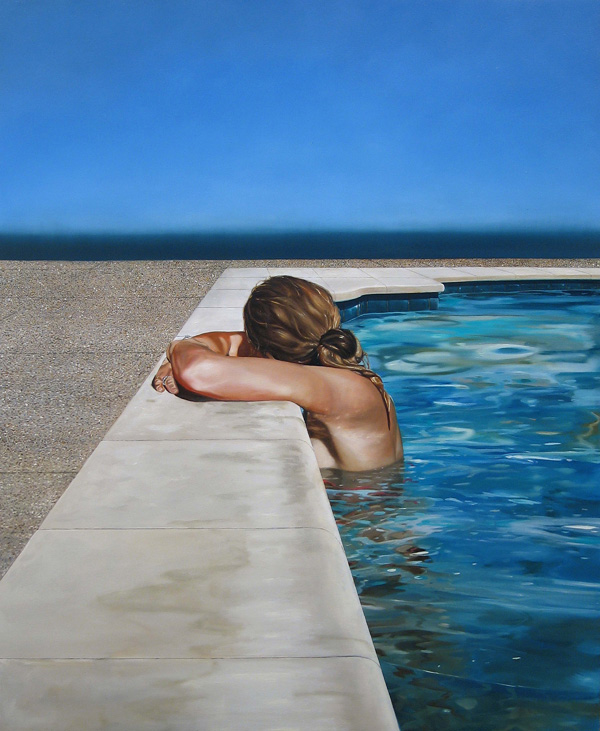
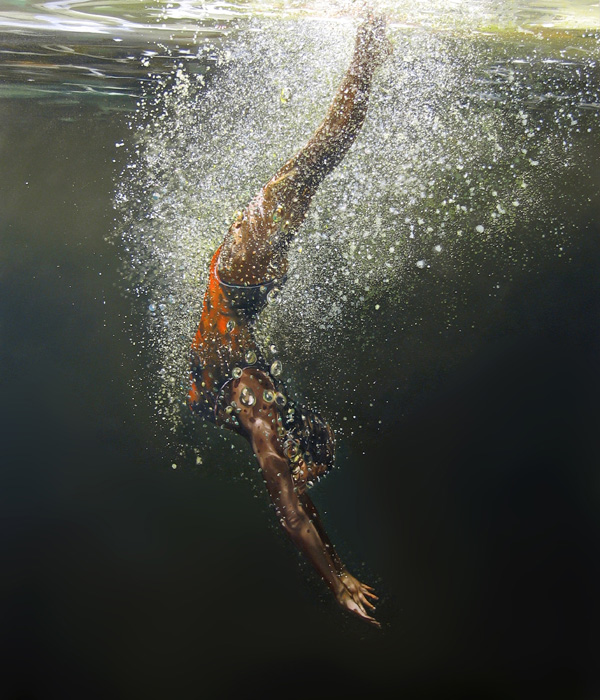
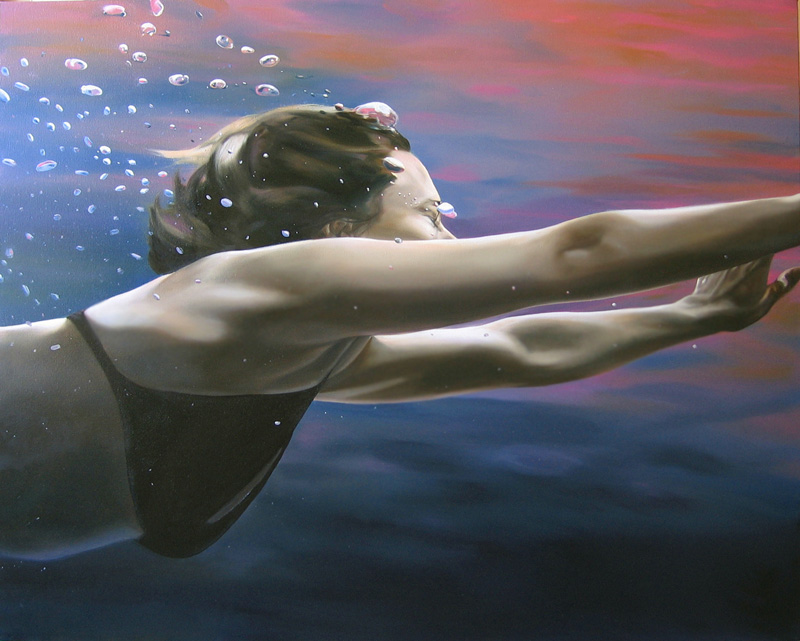
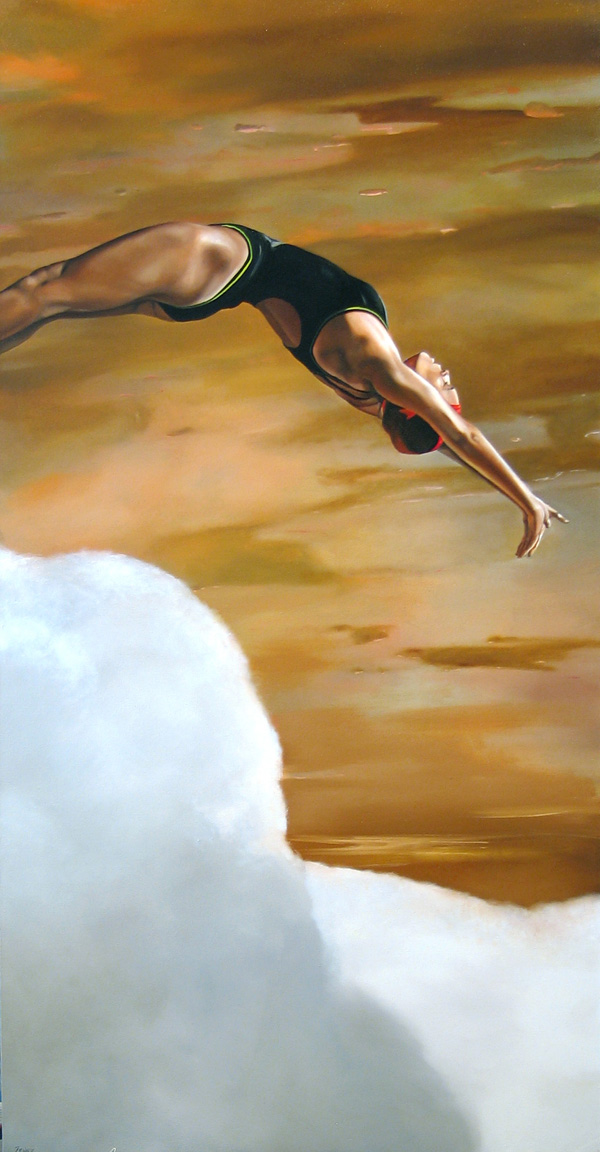
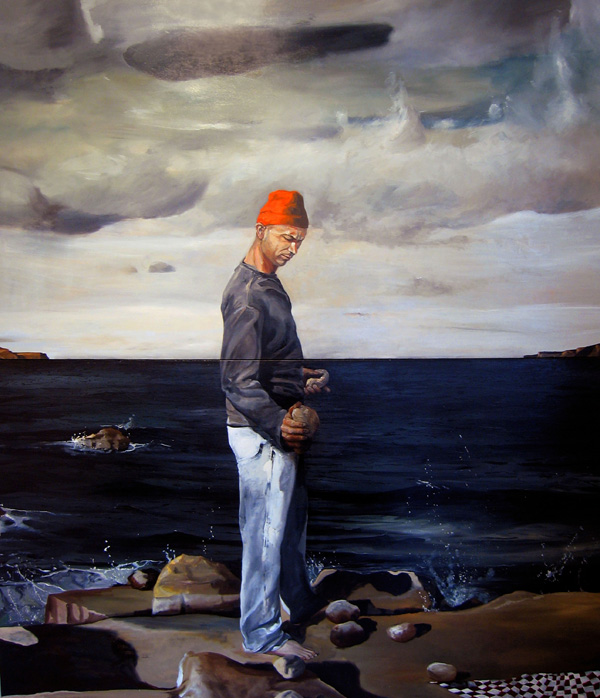
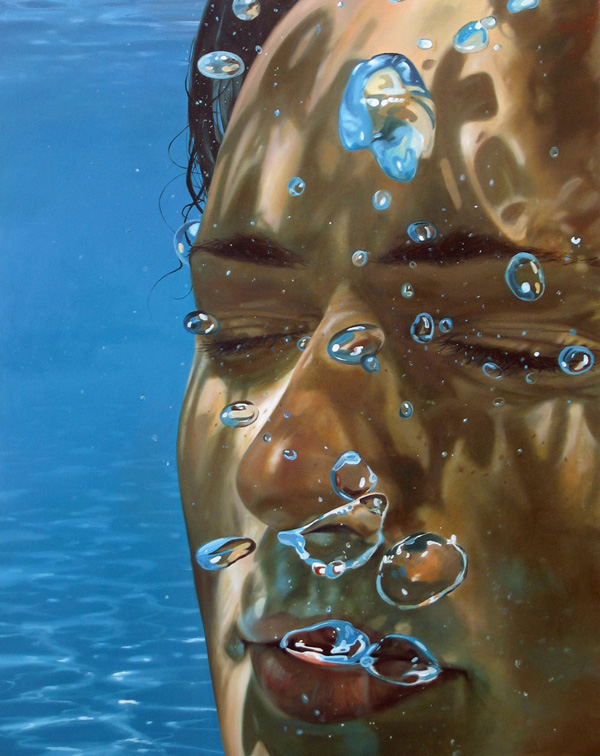
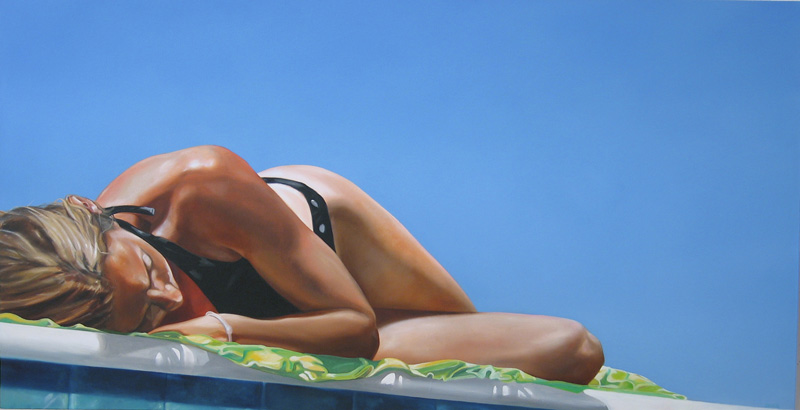
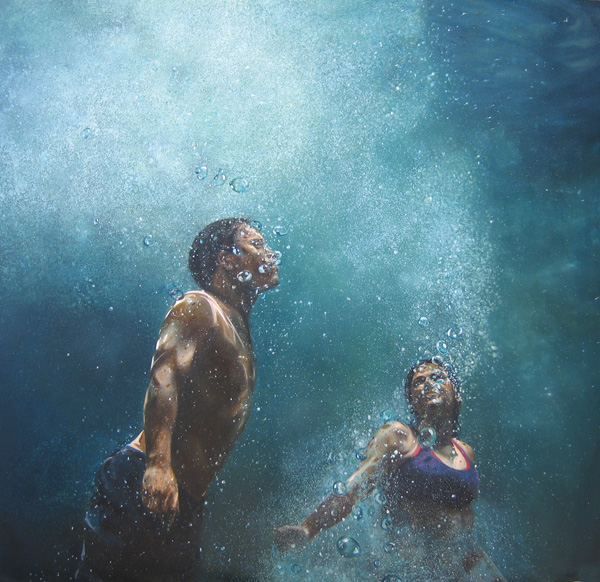
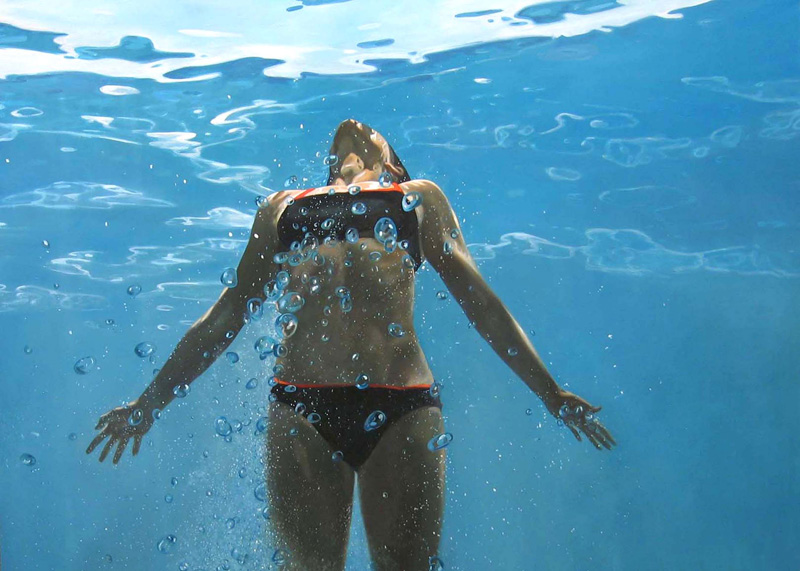
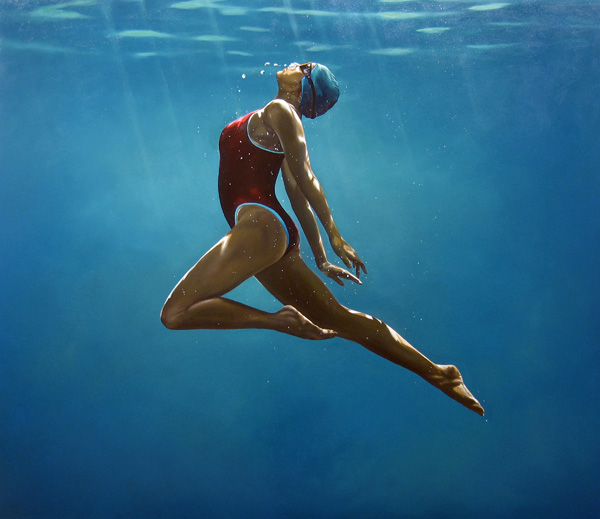
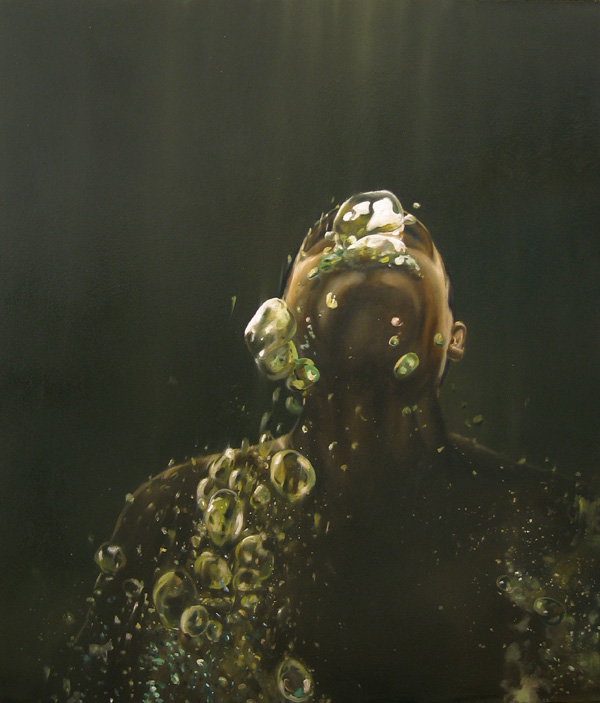
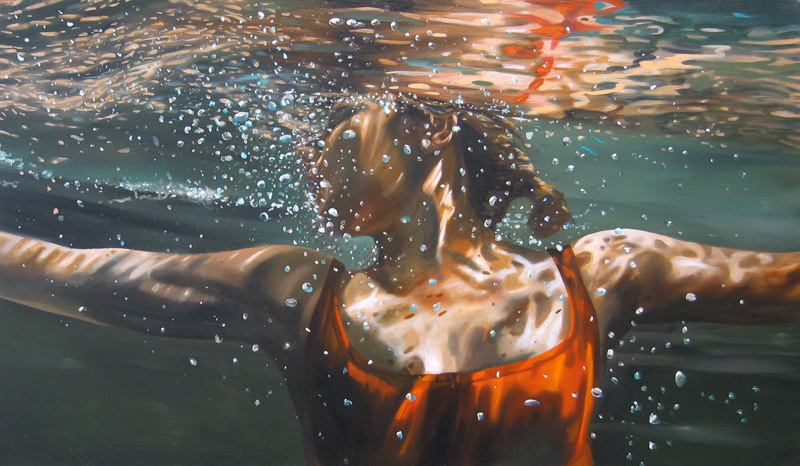
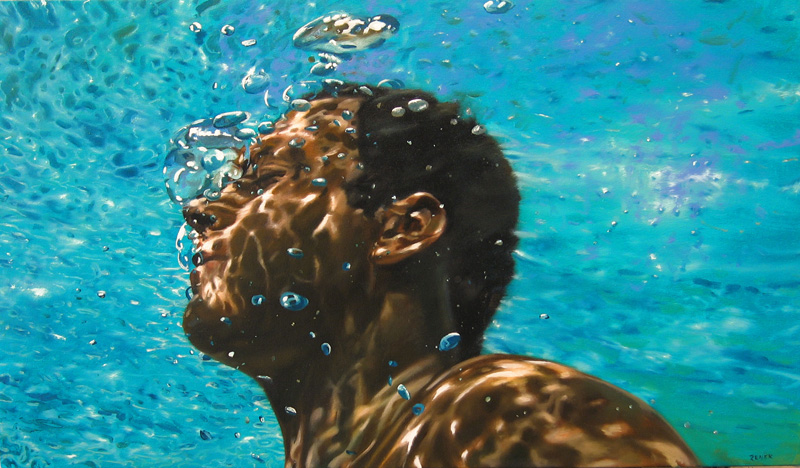
The symbolism of swimming is well-worn territory. We all realize that water represents transformation, rebirth, and tranquility. But Eric Zener’s work reminds us of the real power lakes, pools, and oceans have over our imaginations. Because, who wouldn’t want to be asleep by the pool right now?
All images courtesy the artist. All images copyright © Eric Zener, all rights reserved.
How did you come to paint underwater figures?
It was a natural evolution. It wasn’t as though I woke up one day and said, “Hey, this would be cool to paint.” When I look back at my whole body of work of 10, 15, 20 years, I can see where [these themes] start to pop up. One thing will lead to another, and at some point—and I think this is common for a lot of artists—something sort of locks on and you get deeper into it.
What precursors to these water paintings are present in your earlier work?
It popped up a lot partially because a lot of my work in the past dealt with these languishing figures: lovers lying on hills by the ocean, for example. Little pieces of that started to slip [into my work]. But, I think the most significant time I started painting a lot of water was in 1997 when my wife was pregnant with my first daughter. Seeing what she was going through, and what we were going through—water is a powerful symbol. I think a lot of women get [enveloped] in a giant wave, you know, calm women in a turbulent sea, strength in this big unknown.
How do you understand water now, since you’ve been painting swimmers and dealing with its themes for so many years?
I think the reason I’ve enjoyed it and stuck with that theme for four-plus years now is that I really appreciate the metaphor. To me [the figures in my work] are not just swimmers. It’s about the concept of transformation and renewal and replenishment; that sense of discovery that water physically offers us. I also think there’s a subconscious reason why we’re drawn to bodies of water.
Why are you drawn to water?
When we’re around water or in water there’s a universal sense of calm, a personal baptism. It’s cleansing in so many ways: psychologically, physically. Water’s a powerful force. It’s both friend and foe. At the beach someone could be drowning, but a hundred yards away people are having the time of their lives.
The titles of your work have a sort of consistency, but it’s hard to put my finger on why exactly. How do you come up with these them?
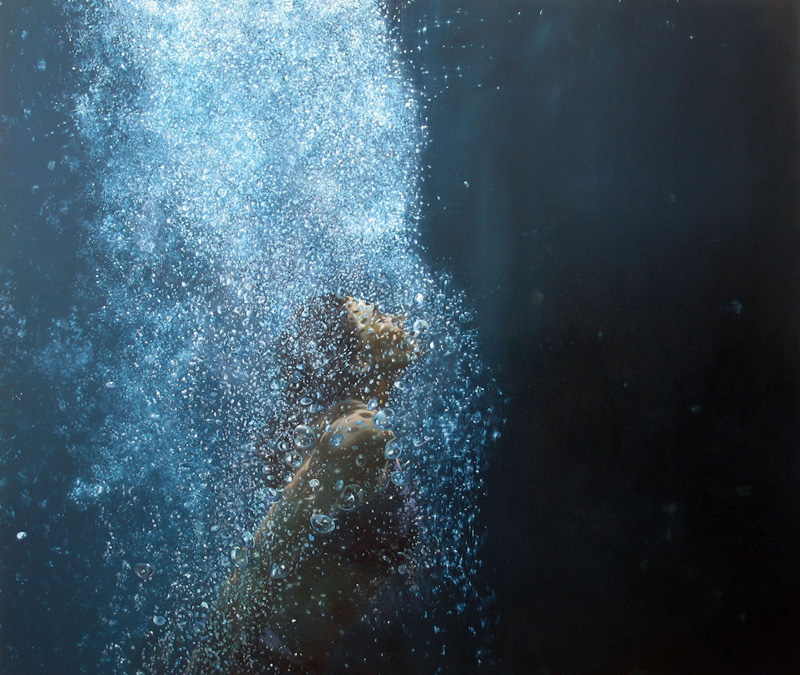
The titles come to me at the very last second. They usually reflect what I was feeling when I was painting it. I’m hoping that the paintings convey that sense of being unleashed, unbound, or breaking free. [In my work] the bubbles for me are all about the past. They [represent] memories.
Do you identify with the figures in your paintings?
In most of the work the people have a sense of anonymity. I do that because I’m hopeful that the audience can project themselves into the figure. When confronted with an actual portrait of someone, you’ll think—oh that’s someone else. But having the figure turned away, you can’t identify it.
Do you paint from photographs?
I don’t have a super-strict methodology. However I need to get things done, that’s how I work. The big portrait “Relinquishing” is clearly from a photograph.
Most of the paintings are from a compilation of different photographs. In the studio, I’ll get up on a ladder and [have my models] lie on the ground with their arms propped up on pillows. It looks really silly, but I’ll get the pose I’m looking for. Except, maybe the arm doesn’t come out right, so I’ll just draw that. Or an arm from someone else looks really great, and I’ll use it with a photo of somebody doing something else. They’re Frankensteined together. Occasionally, I’ll get a really nice shot and occasionally they’re drawn freehand. The painting “Breaking Free,” that’s just a drawing.
What reaction have you gotten to this work? Do people identify with your paintings?
It seems that people understand [these themes] on the same level as I do. Our lives are very busy and I think that these images offer a sense of reprise. I’ve heard people say, “You’re painting where I want to be.” Who wouldn’t want to be asleep by a pool?