
Ben Katchor
Our man in Boston talks to author and artist Ben Katchor about the history of picture-stories—from the days when literature included drawings to our current world of (sadly) more purified genres.
Before Art Spiegelman’s Pulitzer Prize-winning Maus, I hadn’t looked at picture magazines since my MAD-magazine adolescence. When I caught up with Spiegelman around the time of Maus he was very admiring of a “cartoonist” named Ben Katchor, who produced a serialized picture story, Julius Knipl, Real Estate Photographer. A few years later, I caught up with Ben and had the first of a number of conversations.
For the chat that follows I met Ben in front of his hotel and we proceeded a short distance in my car to the Commonwealth Mall (think trees and statues, not commerce), parked in the shadow of a statue of Gustavo Sarmiento, and had a lengthy conversation in my ragtop, al fresco (meaning with the top down).
You will note quickly, as befits a MacArthur Fellow, Katchor has an original take on almost everything. In this discussion we talk about his most recent book, The Cardboard Valise; designing for e-books; comics; writing librettos; Menasha Skulnick; the benefits of receiving a MacArthur; writing biographies; writers who paint; and, as the preceding suggests, a wide swath of other subjects.
All photos © copyright Robert Birnbaum

Ben Katchor: Is that really picking us up?
Robert Birnbaum: Sure is—it’s pretty good. OK, I am talking to Ben Katchor. Benjamin?
BK: (gives a quizzical look)
RB: Bennie?
BK: (with an accent) Bennie? Nobody calls me Bennie.
RB: When you were a kid?
BK: No. Ben.
RB: My dog is named Beny. Not Ben. Benjamin.
BK: No, Ben or Benjy. Not Benny—that’s more an adult nickname.
RB: A famous singer in Cuba was named Beny [Moré] with one N. Anyway, is your book coming out in a Kindle edition?
BK: No. It was supposed to be released with a simultaneous e-book.
RB: How could this be an e-book?
BK: It can. The thing is, the arrangement was that it has to be in a format that would work with every device—Kindle, iPad—
RB: Smartphone?
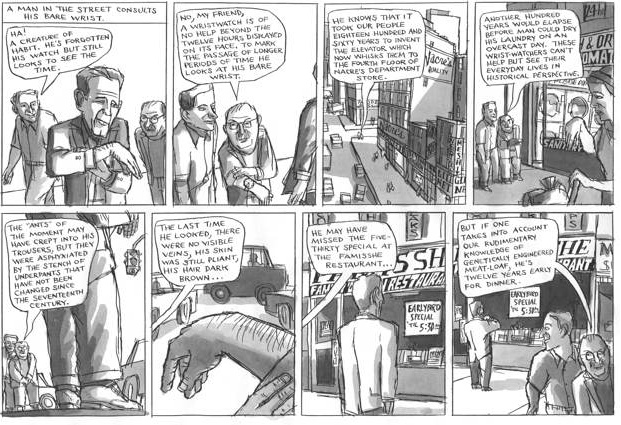
BK: Probably. That format is an .epub format, which is based on flowing text. And since this book is not a text file, you can position images in that program, but it’s very clunky. They tried to do it and it wasn’t good enough. That was the alternative of designing a specific application for that book.[[1]]
RB: You’re all right with an electronic iteration of The Cardboard Valise?
BK: Sure, at least you’d have to look at it panel by panel.
RB: You were just saying to me (as I was setting up my recorder) that part of the intent of this book was to reflect on the death of the culture.
BK: Well, I think it’s had its life. And it is probably changing into other things. A book is a book, and an electronic device can do things that books can’t do, and so these things can coexist. The thing is that the physicality of books makes them kind of a luxury—like driving a Cadillac.
RB: A luxury for what kind of person?
BK: To the whole ecosystem. It’s a luxury to sell paperback books that require 30 gallons of water to produce. And they are disposable now—paperbacks are not things you necessarily will keep.
RB: Geez, I have thousands of books—what am I going to do?
BK: So do I.
RB: And many are signed first editions—that is part of my legacy to my son. Am I burdening him with a ton of pulp? Or is he being left something valuable?
BK: Um, I don’t collect first editions—I never got into that particular fetish—
RB: (laughs)
BK: A literary fetish. But you know, I don’t know I think you can confuse the object for what makes a book a great thing.
RB: The most valuable books in the 19th century were books that were never opened—their pages were never cut open.
BK. Yeah. There’s that famous story that Rosenbach, that rare-book dealer—there was a rare, multiple-volume edition of Tom Jones, and it was passed through about six collectors for a lot of money at that time. And then finally someone, by chance, who was stuck in Rosebach’s home, wanted to actually use it—to write something about Tom Jones. And he realized it was a forgery. Forget about reading, it was never even [previously] opened.
RB: I thought you were going tell me it was blank.
BK: So anyway, if you want to collect objects, you can collect lots of things.
RB: In defense of my fetish, these are read and from authors that I have spoken with. And I don’t treat them like—some of them have coffee-cup circles on the dust jacket and such.
BK: So you use them.
RB: Yeah. So what would I do with them?
BK: Put them behind a sealed glass case. The thing is, it’s really odd to me that prose writers, that people that make mainly prose books, [are] working in a form that came into being because the Puritans drove playwrights off the stage, so they had to invent the novels. So they pushed all this physicality out of this art form—they reduced it to words, to conventions. And then they say, “But we miss the feel of paper.” Like that’s the last physical thing on earth that’s left to them in their art form, the smell of paper. What about the entire visual world? The book’s physicality is one small element of an entire physical world that they’ve already dispensed with.
RB: When you draw, what do you use?
BK: For many years I used pen and paper, but for the last year or so I am drawing on a Cintiq. And that’s because a lot of my work—even the print stuff—is all digitally processed. Except for small-press, antiquarian printing aficionados, all mass-market printing uses digital pre-press. My work online is digital, and my work in the theater is digital projection. So that’s a technology I have to use. And it’s more—
RB: You don’t have to use Wite-Out.
BK: If I go from a paper drawing to a digital image, I kind of lose things in the translation. It has to be scanned, and it degrades a generation. And it really looks better drawn directly in the digital medium. It’s a more subtle recording device—like the difference between listening to someone’s heart and using an EKG.
RB: Do you still draw on paper?
BK: Occasionally, but most of my work that is done for magazines, theater, or books is done digitally.
RB: What I am asking is, do you draw for pleasure?
BK: No. It’s all agony. I don’t draw for pleasure.
RB: (laughs) Did you ever?
BK: I think early on it became this agonizing thing, drawing, trying to make these images. No, it was always—I think people who have fun making drawings are hobbyists who are looking for a pleasurable alternative to their real work. If I want to have fun I take a walk, or sit in a park. What I do for fun—I go to a restaurant. I do other things than to try to make picture stories: That’s agony. Hopefully, the reader gets something out of it. But it’s even hard for the reader. I don’t think my books are easy reads.
My digital files could be output to fill the proscenium of a large theater—there’s that much information there.
RB: My recollection of comics was that they were rarely funny. Do you call your books “comics,” or “graphic novels?” They are funny.
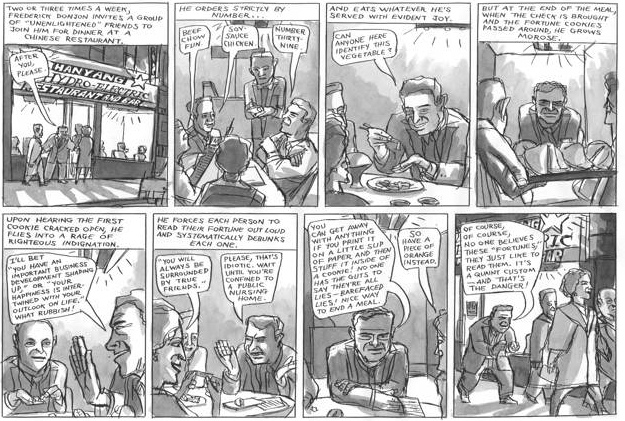
BK: “Comics” connects you to an old and long tradition that I may be part of but I am also working in opposition to. So the form needs a new name. Some people call it a graphic novel, but all novels are graphic. Otherwise you couldn’t see them. They use typography. My idea is to call it “autographic writing.” I am a writer, but I am interested in my handwriting. Most writers don’t want to preserve their handwriting. They choose to set their words in mechanical type, so all traces of physicality are gone. In my writing, I want to preserve my handwriting, and my handwriting includes writing words and images. So that’s probably a better name. And are all “comics” comical? Well, in the ones that strive to be amusing the humor eventually becomes dated. Is Krazy Kat mainly of interest because it’s funny? It’s very amusing, but there’s a lot more than laughter going on while I’m reading it.
RB: I didn’t think Peanuts was funny—
BK: That’s more maudlin, I’d say. It has a sadness. I hard to think of a funny comic strip among my contemporaries—I think of them as pretty dark. Dark subjects or dark humor. You know, Bill Griffith can be very funny, but there’s so much more going on.
RB: Right. B. Kliban—do you remember him?
BK: Yeah. Those were single-panel.
RB: Glen Baxter?
BK: Same thing. Edward Gorey—he was a picture-story writer. It’s highly amusing, but it’s more moving than funny. I think I just want to read it and appreciate the world he’s created.
RB: Besides the connection with juvenile delinquency in the ’50s, why were they called “comics” or “funnies,” if not for some comic aspect?
BK: It was in the American newspaper strip tradition that they were called “comics” or “funnies,” because a lot of them were trying to be humorous. Mutt and Jeff, Our Boarding House, and Nancy—it’s a strange thing; they are more like deeply amusing when they are good. A good Nancy strip is like someone boiling down the idea of a gag to its essence. You just admire how it was done. Other strips were so troubling and dark that you just had to laugh.
RB: R. Crumb?
BK: Yeah, Crumb, sometimes at his best, can be really funny.
RB: And dark.
BK: Yeah, that stuff from his Arcade period is really funny. It’s funny and tragic and obsessive.
RB: Do these strips need to be preserved?
BK: Originally these strips were done for weekly newspapers on newsprint. It’s one of the most ephemeral forms of print, and a lot of them were thrown away immediately. And so the book collection is already a more durable entombment of these ephemeral things. And the digital file, which is now bouncing around and being replicated—that may survive the print thing. I don’t know which is more durable.
RB: Nicholson Baker would say the paper version.
BK: Well, his argument was against microfilm, which was another idea of how you could preserve printed matter. And that was a terrible recording medium, as the image quality was abysmal, if you could even see the image. And it was also on a fragile thing—film, acetate of some kind. And then people though they could throw away the original printed object. Digital file is potentially of a much higher image quality. My digital files could be output to fill the proscenium of a large theater—there’s that much information there. Whether the file itself survives—that piece of information on a digital medium—depends on how many copies there are, what happens to them.
RB: At the turn of the millennium, the Times magazine had a panel discussion of archivists and curators about this matter. The problem with the digital technology is that hardware and software is continually changing.
BK: A raw .tif file or .jpg that was made 10 years ago can still be opened today. You couldn’t necessarily open them in other programs that became obsolete, like early page-composition programs. Some of the raw data can be used and saved. On the other hand, I make prints of my work. I have backed it up on paper, too.
RB: That’s a lot of backing up.
BK: That’s backing up several times digitally, myself. And then my publisher probably has them somewhere backed up. And then every time it was printed in a newspaper, there was a file, and those may be floating around. Who knows how retrievable this will be 100 years from now? It’s an interesting thing. I know the internet is archived every day by some association that backs up the whole thing. And you can go back and look at your web page from eight years ago, and a lot of the internet from that period will be there. If you think about what’s survived in print—it may not be that much. There are lots of books that have dwindled down to a few collectors’ copies. Things get thrown out, things burn—especially in very volatile times. People think there is a whole body of very early Yiddish literature there is no record of anymore because—
RB: Isn’t there a Lithuanian library that has recovered some of it? And an archive in Western Massachusetts?
Anything that at this point makes a book look like an alien object or an unfamiliar object is probably a good thing. So people will not take it for granted that it’s a book.
BK: Yeah, that’s mainly 19th and early 20th century. I am talking about earlier printed books, and it got lost. Things get lost.
RB: Do you have every drawing you have ever done?
BK: I don’t think every one. I have given some away, lost some. I have a lot of them, but they are mainly on paper. It’s a big thing to get used to. Filmmakers live with this all the time. Their work is on this medium that can disappear—now they are all working digitally, and they are all having trouble keeping up, and backing up their movies. So this technology has definitely pushed books into the immaterial realm.
RB: That fascinates and is what is fascinating about classicists—they acknowledge and even savor the fact that they deal with fragments. They often don’t deal with complete texts.
BK: Yeah. You can tell a lot from one of my strips. The whole book is one thing. It existed in fragments—published serially.
RB: That’s what I am trying to understand. In the last few years you have published three books—
BK: I have been doing weekly strips and monthly strips all along. The books are a sideline thing.
RB: At what point do the strips become books?
BK: When I feel like packaging them in to this new thing.
RB: And in the case of The Cardboard Valise?
BK: This waited a long time.
RB: Do you have to change anything to ensure continuity when you make the book out of strips?
BK: No, because in this case I wanted to preserve that free-associative feeling of a weekly strip—how I invented it week by week. And I went back to flesh out the narrative at several points.
RB: So you did change it.
BK: I added to it. I rarely went back and made changes. It’s more or less as it originally appeared: a record of this weekly event. It’s a graphic novel in the form of a weekly comic-strip, if that makes sense.
RB: And The Jew of New York?
BK: That ran for a year as a weekly strip, and then it was expanded and rearranged as a book to become twice as long. That was different.
RB: There are foreign-language editions of it. Who writes the text?
BK: Sometimes people will try to copy my handwriting. Usually it’s done with a font of my handwriting. It’s not really necessary—you could put out an edition with subtitles at the bottom of the page and preserve my handwriting. That’s what I would prefer.
RB: Have you seen a book that does that?
BK: Yeah, the new English translation of Rodolphe Töpffer’s complete work. He was an early Swiss picture-story writer. You wouldn’t want to efface his handwriting—it’s part of the graphic quality. So it’s published with the original French handwritten text and typeset below in English. That’s done occasionally with historical material. There is a newsprint magazine in France, l’Episode, that presents the original version and subtitles, either English to French, French to English, German to English. Subtitles, as in movies, are really easy to do.
RB: I don’t see how the text in The Cardboard Valise could be effectively translated.
BK: I don’t think it can be. I don’t know than any prose can be.
RB: Some of the text is solecisms. I wonder if they exist anywhere else. They are understandable.
BK: I don’t know that certain writers translate very well. The Japanese edition of Julius Knipl, Real Estate Photographer: Stories has a large section of notes in the back that explains everything. It’s as long as the book.
I think people who have fun making drawings are hobbyists who are looking for a pleasurable alternative to their real work.
RB: The explanations are in Japanese.
BK: All in Japanese.
RB: How do you know if the explanation is correct? (laughs)
BK: I don’t. I assume that someone who was interested enough to do that did their best. But I like to read things in their original language, if possible. In comics, at least the images, on some level, transcend the need for translation, and so you’re at least getting half of the original. In some European countries they’re consciously trying to keep their languages alive. Especially for things like comics, so kids can keep reading Flemish, keep reading Dutch.
RB: Holland does get a lot of books in English.
BK: Yeah. There is an organization there that promotes Dutch-language comics, and they give cartoonists grants to work in the Dutch language.
RB: It’s a difficult language to pronounce. In WWII the Dutch resistance used specific Dutch words as passwords that only a Dutch person could pronounce—this helped to guard against infiltrators.
BK: I didn’t know that. Some countries tend not to bother—Portugal tends to just import the English books.
RB: In Latin America books are fairly expensive, and book-buyers are a rarified group and, I suspect, facile in English.
BK: They have price controls in France that keep the prices up to what they should be. If the digital file that my book was printed from starts being passed around, that would cost nothing to replicate, and more people would end up looking at it somewhere.
RB: That being a democratic feature of the internet. How labor-intensive is assembling a book?
BK: Assembling it? Or making it?
RB: After a period of time you have a number of strips—
BK: If it was drawn on paper it has to be scanned, and then the image files are positioned in a page-composition program like InDesign. Whatever other element you want to invent—endpapers, contents page—and the cover has to be designed.
RB: And the endpapers?
BK: Well, the endpapers in this book are not just decorative—they are part of the story. The design and layout is the least of it.
RB: Whose idea was [it] to have a handle?
BK: Chip Kidd’s idea. He said, “Take a look at this, see what you think of it.” I saw and I liked it. I suggested it just be this neutral sky-blue color. It looked like some kind of take-out container, a strange food-carrying container. I said, “Anything that at this point makes a book look like an alien object or an unfamiliar object is probably a good thing.” So people will not take it for granted that it’s a book.
RB: Chip is a fun-loving guy. So, my guess is that you are always busy. Are you doing one strip a week?
BK: No, no, I do a monthly now [for Metropolis], which is a larger work, and so a lot of work’s involved. I am always working on some theater piece. And I teach. I am on the faculty at Parsons and The New School. That keeps me busy. I don’t have a lot of idle time. I’d love to have that kind of time where I could just take purposeless walks, but I don’t have that. I love to be in a position where I don’t have anything to do; I can just be somewhere, sit around and wait for someone to arrive. I try to take advantage of those situations.
RB: When you were in Porter Square [for a reading], did you walk around?
BK: Not too much, because I had to find the bookstore—
RB: It’s in a strip mall.
BK: It’s always sad to go into a bookstore in a shopping mall. It’s not my culture—I have rarely lived in a car culture. And that [Porter Square, Cambridge] doesn’t seem like it should be. It seems like a walking neighborhood.
RB: That mall/shopping center has a big grocery store.
BK: The rents must be cheap enough for a bookstore—not like on Newbury Street [Boston].
RB: I don’t think there are any bookstores left on Newbury Street.
BK: Last night I went to one that’s also a diner.
RB: Oh yeah—the Trident. It’s probably still around because it sells food.
BK: Yeah, it’s mainly an eating-place. What was that one that used to be across—
RB: Avenue Victor Hugo Bookstore?
BK: No.
RB: Waterstones?
BK: Near Waterstones, on the other side of the street.
RB: Harvard Bookstore Café, owned by the same man who owned the bookstore in Cambridge. So, you seem to like writing librettos.
BK: Yeah, well—
RB: Can you sing?
BK: No, but I can speak. And the kind of music that these shows use is just human speech, ratcheted up, just a little bit, to music. That’s the kind of music Mark Mulcahy writes. They are sort of ballad operas.
RB: There is only one recording, as far as I know.
BK: That’s The Carbon Copy Building, with music by the composers from Bang on a Can. My collaborations with Mark Mulcahy have not been put out as recordings, and that has to do with the question of who’s still buying CDs or physical records.
RB: You design the sets also?
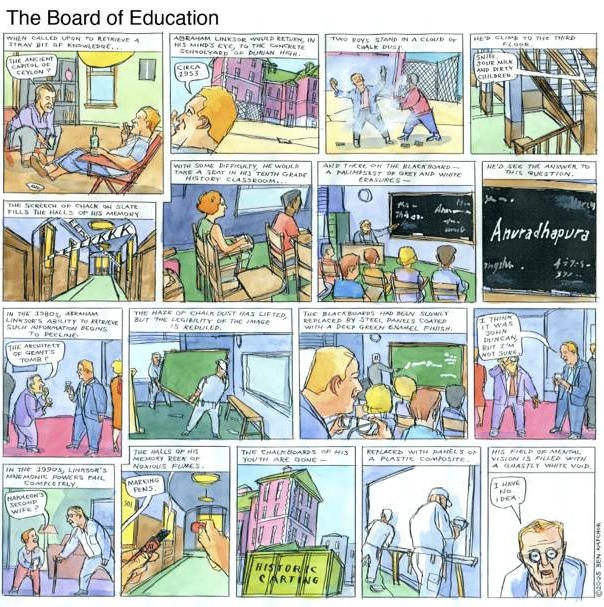
BK: Yes, I design the projected sets—they are really central to the show. The shows would not make much sense without them.
RB: So a DVD would be more appropriate.
BK: Yeah, it has to be a visual thing. The Carbon Copy Building CD was an illustrated book—a scene from each scene of the opera. It should be more like an animated film, but that’s a lot more work.
RB: Have you done any animations?
BK: I’ve done some limited animation in those shows—it’s more of a sequencing of images that follows the music.
RB: Would you like to make an animated film?
BK: Yeah, I think all of our “operas” could be made into animated films.
RB: What would it take?
BK: A lot of work. Somebody to oversee it and a lot of production work. It’s very labor-intensive work.
RB: Which also translates to money.
BK: Unless you can do it yourself. So, anyway, that’s one of the problems with packaging these shows and then having to sell them. At the moment, they exist as live events. You have to go out of your house and sit in an audience and be there with these other people.
RB: Are there other productions of your “operettas”?
BK: As long as we’re around, we like to control them. If you gave them to somebody, it would be a disaster, out of control, and that doesn’t interest me. It would need my pictures. If you didn’t use my pictures you would have to invent a whole new scenic world, and it wouldn’t be the same. And as I said, some day if somebody wants to do it (chuckles), they could do it. At the moment we want to control how they are done. We don’t get to do them that often. Mark sings in them.
RB: Has anyone videotaped any of the performances?
BK: Yeah, yeah. But just to document them.
RB: One camera.
BK: Once somebody put together a more elaborate video, but filmed opera productions tend to feel too stagey and big. You’d have to redesign it for video, and make the performance more intimate for close-ups, etc.
RB: I have always preferred Shakespeare on film.
BK: It can be done. You must have seen good ones. Great films have been made.
RB: Orson Welles as Macbeth, John Hurt as Richard III, Paul Robeson as Othello, Olivier as Hamlet and King Lear and other protagonists.
BK: They are probably better than 99 percent of the live productions. But somebody has to do it. If I had the time —
RB: Have you seen Al Pacino in The Merchant of Venice?
Everybody has this fantasy that “When my book comes out my life is going to change.” Or, “When I get the award, my life is going to change.” And in some cases it probably does. In most cases it doesn’t.
BK: No.
RB: It’s a bit comical.
BK: I can imagine. I have nothing against filming plays, but I do like live performance.
RB: Do you go to much live theater?
BK: Not as much as I want to. It’s hard. There’s an obstacle—even in New York. I try to.
RB: Listen to live music?
BK: I try to. Like last night, somebody took me to a Jewish music festival—it looked like an old wedding hall in Brookline. There was a really good band—this guy from Montreal, Josh Dolgin. It was great, kind of hip-hop klezmer. He did covers of Menasha Skulnick, a Yiddish theater performer from the ’20s and ’30s. And I said, “Somebody is covering Menasha Skulnick, these incredibly obscure things that only exist on 78s.” Eventually everything will be covered (laughs). Everything will have another life. Nobody has performed these songs for probably 20, 30 years or something.
RB: You don’t know that. Maybe on some kibbutz in Israel—
BK: Well, I doubt it. I follow Yiddish music and would have heard about it. A lot of things have been covered and revived, but not that. (laughs) It’s very deep in the basement of this culture. So there it is, this 20-year-old guy.
RB: Howlin’ Wolf, a raw Chicago bluesman, is now the background music for Viagra commercials. Howlin’ Wolf (laughs).
BK: Pretty amazing. In the Coen brothers’ [A Serious Man] film they used a track of Sidor Belarsky, who was a very well-known Yiddish art-song singer.
RB: Art-song?
BK: Yeah, he sang Yiddish art songs.
RB: What’s that?
BK: Songs sung by a trained singer from classical repertoire. A short song—like Schubert.
RB: Like Lieder?
BK: Yeah. And they [Coen brothers] took one, and it was a repeated piece of background music. So these things come up again.
RB: Perhaps that’s just a mirror of human memory, in that we don’t really ever forget anything. You can’t always recall, but everything that you experience makes an impression of some kind. Sometimes they come back at the oddest times.
BK Triggered by something, some incredibly complicated chain. And then you’ll think of the thing, not the chain. The chain will just be there.
When I read a good biography I feel like it’s all being filtered through one voice. I’d actually rather hear those voices.
RB: The image, the smell.
BK: Yeah, so it will work like that.
RB: You had someone who actually invented a machine to broadcast smells (laughs).
BK: An Odorater. Would you buy such a machine? There isn’t a real art form around smell—maybe perfumes. It’s a completely unexploited sense. You have whole industry—
RB: I always wonder how smells stay in a place, and people can smell things much after the smell-producing thing is gone.
BK: Some people have an incredibly sensitive sense of smell. My wife, for instance—it’s almost frightening, her sense of smell. She’ll say, “That car over there smells bad,” and she’ll get it well before anybody else does. The molecules hit her first. Animals must have incredible senses of smell—
RB: And sight. Is there something that you haven’t done that you would like to do?
BK: Uh, let me think. (long pause) Yeah, of course. I would like to tour these shows more. It’s more of the same thing. I wish these shows had more of a life. We could do a big tour with every new show.
RB: Is that fun, or agony? (laughs)
BK: No, that’s fun. Collaboration, once it’s all worked out—the agony part of it. Since I’m not in them, it’s very nerve-wracking, making sure the technology is working—then they are fun. The agony is waiting for the technology to crash. I am so nervous sometimes I can’t even be present. It’s good to have other people involved—if all it’s on you, it’s pretty nerve-wracking.
RB: Did your life take a measurable turn when you received the MacArthur Fellowship?
BK: Not really.
RB: It must have made things easier?
BK: Yeah, it’s easier. I wouldn’t say an abrupt shift, but it’s made some things easier. I feel it helped getting a teaching job. It’s a certain kind of a certification, like Good Housekeeping. It gave me a lot of time to put a lot of money into developing these shows, to underwrite these things. There’s never enough money to do what we’d like to do.
RB: Did you buy yourself some toy that you really liked?
BK: Not a toy, but we bought a place in the country.
RB: That’s a nice toy.
BK: It’s not a toy, it’s more of a—
RB: Appliance?
BK: Everybody has this fantasy that “When my book comes out my life is going to change.” Or, “When I get the award, my life is going to change.” And in some cases it probably does. In most cases it doesn’t (laughs). And those are the levels of celebrity in this culture—
RB: That’s a pretty creditable accolade. The people who get it are, by and large, worthy.
BK: “By and large”? (laughs) I try to pick out the ones that I think are really great artists—Paul Taylor, and Ornette Coleman—and I say, “They got a MacArthur, so it must meant something.” I can’t look at the grand scheme of that fellowship, as it involves many disciplines I know nothing about.
RB: Has anyone who does what you do received a MacArthur?
BK: I don’t know. I don’t even keep up with the yearly awards.
RB: I do—I have the unreasonable hope that the Fates will smile on me.
BK: Is literary interviewing recognized?
RB: Who knows?
BK: You could be the first.
RB: I am not sure that these are interviews.
BK: They are done at a level of relaxation that commercial journalism couldn’t deal with.
RB: (laughs)
BK: I mean, they are sort of interviews—I don’t know what they are.
RB: Right, what are they? It’s just talking, that’s what I say. That’s what I’ll call my memoir: Just Talking.
BK: There’s a radio show interviewing lot of comic book people called Ink Studs. They are really long, like four hours. He’s compiling books out of them.
RB: Richard Schickel did a book called Conversations With Scorcese. And the U of Mississippi Press has a series called “Conversations with…” My “interviews” appear in some of those.
BK: There’s a whole series with cartoonists. Hopefully this interview will be included in mine, if it ever exists. (chuckles)
RB: I like the oral biography, composed of conversations with people who have known and dealt with the subject. There’s one of Warren Zevon, and one of Robert Altman. And, I think, one of Edie Sedgwick.
BK: Oh, there are these things online, from some film institute somewhere on the West Coast that has these really long interviews with people in show business.[[2]] Have you seen these?
RB: No.
BK: They are sitting in front of a camera telling their whole life story. And they are amazing. I remember one with Jonathan Winters—they are pretty amazing. The only danger is—
RB: The other way, you get these highly detailed biographies that tell what the person ate for breakfast as a seven-year-old—
BK: The only danger is you have things you may not want to talk about, and you highly edit it.
RB: That’s why in a book you have other people as sources and witnesses.
BK: You want everybody to talk about one subject?
RB: Yeah, the wives, the kids, partners, collaborators, high school teachers, cellmates, etc. You get a pretty interesting picture. Is it real? That’s for the reader to figure out.
BK: There must be a lot of obvious contradictions. Yeah, it could be fun.
RB: What is the point of reading about someone, anyway?
BK: You want to know the world they lived in. When I read a good biography I feel like it’s all being filtered through one voice. I’d actually rather hear those voices.
RB: I like those slim, 200-page biographical essays: Larry McMurty on Crazy Horse, Christopher Hitchens on Thomas Jefferson, Francine Prose on Caravaggio.
BK: That could be good. I’m trying to think if I know anyone’s life without having to do research.
RB: Whom do you admire?
BK: In my world, early cartoonists. And I think about it, and if I don’t do it nobody will. I could, probably. On the other hand—
RB: There was someone at The New School who had a poetry class/workshop, and in the ’60s, on a weekly basis, well-known poets were invited and the classes were taped. Within the past few years someone published the transcriptions of those classes—not lectures. More like colloquia.
BK: What did they talk about?
RB: I would suppose poetry.
BK: The only other thing about these transcriptions is you lose all the physicality of the voice.
RB: Right, but putting some extra-textual helps: “laughs,” “long pause,” “stares off into the distance.”
BK: Yeah, but since this technology exists you can just hear the thing—you can just edit it. You could be doing a radio show—
RB: There’s a big difference between hearing and reading words—
BK: So I’d like to hear that. Some people transcribe radio documentaries into books, but they are somewhat meaningless without the audio—without the particular human voice. It’s a complicated thing. Our opera, The Rosenbach Company, it’s a musical biography of the Rosebach brothers.
RB: Book-dealers?
BK: Yeah, [Abe] Rosenbach in Philadelphia, and his brother was an antique dealer. They worked together, financing one another’s obsessive hobby. There is a lot written about them. There is a long biography that’s written from the point of view of the antique book world, and lots of shorter things by employees of his. I read all of that and made it into a two-hour musical. So I have done a biography. It is really his life—from his childhood to his death. It was very hard to do. There was so much—this man’s life was completely archived. Nothing was thrown away. And what you have to do is say, “Am I putting too much of his philandering in? Or too much about his Judaism?” What’s the perfect balance? I took out stuff about his drinking. I don’t want to make it look like he’s just a drunk. (laughs)
RB: How is it that you think you can do this so well that you know what the response will be?
BK: In the case of theater, I don’t think you do know until it happens. It’s a very mysterious thing.
RB: Well, you know that people will like it or not like it.
BK: In theater it’s somewhat out of control. It’s a collaboration—until it happens in front of an audience, you don’t know. Absolutely, there are these surprise moments that you thought were throwaways, and they become the center of a scene. You never realize that.
RB: All your efforts to balance—
BK: Yeah, they get thrown out, because somebody will come and see it and say, “He wasn’t a collector of pornography. You overemphasized that.” And it was like two seconds of the play. But I try to make it the right balance. If you say, “I knew what his real motives were,” I say these were other, side motives that are pushing back.
RB: So that’s your intention.
Most prose writers are using highly conventional language in a conventional way, and they are trying to make some big narrative point. But the writing itself doesn’t have this kind of a thing that leaps into the physical, where you almost shudder when you read it.
BK: I try. It could fail on different levels. Someone could look at the opera and have their own opinion—if they know the story themselves, they may say, “This is a distortion.” The effect on the audience that knows nothing about this man [Rosenbach]—
RB: Why would I want to see it if I knew nothing about him and his history?
BK: Well, they know there is this rare book library in Philadelphia, but they may not know who Rosenbach was. They know the institution named after him. In Philadelphia, up until the ’50s, it was a very well-known decorative arts shop, a household name, but the details of his life were unknown.
RB: Is the Rosenbach Museum well-endowed?
BK: I don’t know much about their finances. They raised some of the money through the Pew Foundation. But it’s an interesting place. Rosenbach collected a lot of illustrated books. Maurice Sendak gave them his archive. Our opera commemorated the 50th anniversary of the library.
RB: The museum was created posthumously?
BK: The Rosenbach Foundation was created by the surviving brother, Philip, an antique dealer. The book-collecting brother would never have done it—he would have just put the books back into circulation. Philip had more grandiose ideas about what to do with their home and collection. He wanted a museum, a foundation. That’s how these things happen.
RB: Is your teaching integrated into the way you work, or is it a separate compartment?
BK: Well, it’s all about the form of work I do, and it’s integrated in that way.
RB: There are students who want to do what you do?
BK: I wouldn’t say they want to do what I do, but they want to figure out how to combine texts and image. Some of them are writing students who want to add images. Some are art students who want to add words. And there are design and technology students working with games and interactive media who are interested in visual storytelling. And there’s a theater department that doesn’t have a strong visual component—it’s mainly playwriting and acting.
RB: No instruction in set design or lighting?
BK: Very little stagecraft. And these antique media of writing and drawing, they have been split into the disciplines of art and creative writing. I teach out of the illustration program, where writing and drawing come together—comics, children’s books, and illustrated texts. It could as logically be taught in the writing school, but it’s in the art school because it involves pictures. They have to put it somewhere and they don’t want to put it in media studies because it isn’t modern media. It’s ancient mixed media. That’s the distinction that’s made.
RB: Do you know Lawrence Weschler’s book Convergences?
BK: Yes.
RB: That book is a text that talks a lot about various images and their relationships, like comparing Che Guevara’s death photo to some Rembrandt.
BK: An Anatomy Lesson. Wait a minute, isn’t that from John Berger?
RB: He got the idea from Berger.
BK: That’s just prose annotation of images. And these pictures don’t mean anything unless you start saying—it needs both.
RB: Who else besides Berger and Wechsler sees these convergences and foreshadowings?
BK: Every good art history book has illustrations that say, “Look at this.”
RB: Right, but that’s usually taking pictures singly, or placing them within a milieu.
BK: Lots of books talk about the composition—
RB: How would I know? I never read one art history book. (laughs)
BK: Anything talking about the physical world is usually illustrated—archeology; history books need images. It’s only in this thing called “literary fiction” that Henry James said, “I don’t need pictures. I can’t make pictures. And I don’t want to compete with an illustrator.” He said at some point near the end of his life—this text doesn’t need illustration.
RB: Lewis Carroll used pictures.
BK: He did his own pictures for his own editions of his books.
RB: Have you seen Jonathan Safran Foer’s Bruno Schultz book, Tree of Codes?
BK: No, but I’ve seen photos of it.
RB: It’s pretty interesting. What’s striking about it is that as a physical object it’s very fragile. It doesn’t seem like it will hold up after repeated readings.
BK: You know, some books fall apart—paperbacks.
RB: Well, it’s an interesting idea to create a story by subtraction.
BK: Yeah, people have done things like that—annotated books, made books out of other books.
RB: Foer likes to play with type and images in his novels.
BK: Anybody who grows up with visual media—TV, movies, comics, less theater today—wants to think about it. The idea of purity of form, “I am just going to use words or just images,” is the exception. It’s the disciplines in schools that drive these things apart. “I’ve only studied writing and that is all I can teach you. If you want to go mix them up, go be in the gutter. Go be in Hollywood.”
RB: I just read a novel by Jonathan Evision called West of Here, and the author included hand-drawn maps—schematic, not highly detailed. But the way they changed the pace of the story and gave it a different way of thinking about the geography, which included the ocean, settlements, and raw, unsettled nature.
BK: Yeah, images can work to illuminate text.
It’s sad history, this urge to purify the arts. I don’t know what else to say about it. Whatever it did to literary fiction, it did the same thing to painting. It took the stories and thought out of the visual world.
RB: How about a book that is a geographical biography of George Washington? Just maps.
BK: That’s interesting, although maps are a kind of schematic—pull up a map into three dimensions, you get a place, and the place is a map on a rainy day and a map on a hot summer day—it’s the same map, but not the same place. I want to see it in all its dimensions. A map—maps are very interesting and useful, for the names. I love the names on maps.
RB: One of my favorite annuals is the Oxford Atlas of the World. It’s updated every edition and it has all sorts of images, including NASA satellite photographs.
BK: These things—it’s the full spectrum of meaning, from the convention of the word, to these concrete images and individual particular things. And if you can play off that—it’s the actor coming on the stage with a certain posture. He’s telling you the whole story with his posture and appearance, and then he opens his mouth and delivers the words. So words are part of the story, but it doesn’t have to be the whole story. I want the verbiage set in the world; I don’t want the verbiage on a blank page. I want it set in the world, and then it fascinates me.
RB: What happens when you read literary fiction?
BK: I feel most of it is incredibly boring, and those rare writers who, using the conventional symbols of language, give you a physical sensation, are the geniuses of writing. That’s a handful of people. Most prose writers are using highly conventional language in a conventional way, and they are trying to make some big narrative point. But the writing itself doesn’t have this kind of a thing that leaps into the physical, where you almost shudder when you read it. And that’s rare. I would say it’s an unfortunate history, that decision Henry James made a hundred years ago to throw pictures out of literary fiction. A lot of these writers could have made great picture books. Nabokov was a great draftsman; he could have. And there is a whole history of writers who painted and drew. There is this gigantic anthology I have, called The Painted Word, and it’s the history of writers who, on the side, painted or drew. The culture didn’t allow let them to work in mixed forms.
RB: How many tried to be taken seriously as painters?
BK: They were taught that these were separate disciplines, and there is the purity of art and the purity of prose, and that you don’t put them together. They did illustrations sometimes, but mainly they had two separate pursuits, and if you put them together, in the Western culture, it looked comics or movies. It didn’t look like this refined art form. I am sure these people could have produced amazing multimedia art.
RB: What prevents you from soliciting writers you think could do it?
BK: (chuckles) Most writers won’t because they don’t have the training in picture-making. They stopped drawing when they were 10 years old, and assume that the techniques of drawing are a magical gift that was denied to them.
RB: Let’s say today many can’t, but there must be at least a handful that can.
BK: The ones that can draw make comics. The ones that can’t draw make prose books. I am trying to think if I know a writer who is in that dilemma, who paints on the side. I don’t really know any among my acquaintances. And [if they could] they might not want to do publish the work. When the Rodolphe Töpffer created the first modern picture-story, he published anonymously. Local people may have known they were his, but he had career as teacher and writer, and didn’t want to situate himself as an amateur working across media. The other thing is that a lot of people are ashamed to produce drawings with the technical limitations of a 10-year-old when they are sophisticated 50-year-old writers—to admit that their graphic world is that of a 10-year-old.
RB: Jules Feiffer, are his drawings considered refined?
BK: He is an amazing artist.
RB: I know, but to me his visual stuff is childlike.
BK: He’s never slick, and avoids the surface conventions of commercial art, but he’s a very skilled draughtsman.
RB: He is an example of the kind of artist you are talking about—novels, plays, cartoons—
BK: Yes. He has done a strip for most of his life. He’s done picture books.
RB: What are the titles?
BK: Tantrum is one—he’s done many. But he has done a weekly for most of his life. He wrote a few novels without pictures and screenplays. He has integrated it perfectly.
RB: There’s a biography you could do.
BK: He just published an autobiography. I don’t know that I want to offer another version of his life. I tried biography once— The Rosenbach Company—and I felt terribly constricted by facts. And I’d rather work in the world of fiction. But anyway, that’s probably the big obstacle. If you went to a writer and said to them, “Would you consider adding images to your book?” They’d say, “No, this would undercut the skill that I am showing in this other thing I do.”
RB: There was an early argument against music videos—that they made concrete the things that songs usually left to the imagination.
BK: That’s adding a story. Usually done by some crummy director adding a story to a piece of music. When you see a band perform live, they are the visual. And most great pop musicians are great actors, and really great on a stage—you really want to watch what they are doing. The music is there, and then there is this whole physical act. Music videos are trying lay some narrative onto a piece of music. That can be done the musician. Tom Waits has done operas—
RB: With Robert Wilson.
BK: He did an earlier one. But it can be done. But that’s not a music video; that’s something more organic. It’s that simple. The resistance is due to the structure of the academy—people get taught one thing or the other. And by a certain age they say, “I don’t do that; I do this.” They don’t want to be perceived as amateurs.
RB: Does your work meet resistance? I see you being lauded.
BK: At this moment there is enough work in the picture-story form that has been critically well-received, and so people take it seriously. People can look at a picture-story and say that it should be considered seriously as any other form. But you know, for most of my life that was the worst thing you could say about a writer’s characters, that they were like comic-strip characters. That was devastating. That was the end. And now I have lived to see reviewers say, “This book could probably be done better as a comic strip.”
RB: You are like Moses, but have reached the Promised Land.
BK: It is a great time in the history of picture-stories. It’s had other high points, but this is a good moment. My students are being ripped apart by these disciplines, but they all know that can’t be right. If they are anthropologists, they say, “I want to show things.” They don’t just want to describe, they want to show and let you look. On the internet, a page without images feels like a form of laziness, or an easy solution.
RB: McSweeney’s does play at the intermingling of words and images.
BK: Yeah, that’s called illustration, and then there’s realization through images. One is decoration. There’s a lot of that decorative illustration in the print world. In order to break up a body of text you throw in a picture. It doesn’t need it. It could live without it. In Dickens’ case the illustration upstaged his writing. People would refer to the illustration and say, “This is what Fagin looked like.” And he [Dickens] had a lot of problems with that, a lot of conflicts with his illustrators because he felt either they weren’t up to what he imagined, or they were better.
RB: Illustrated because it was serialized?
BK: That’s not why. That was the form. You needed images because readers expected a fully fleshed out theater on paper.
RB: I understand, but were those illustrations carried over to the books?
BK: In the early editions. In the 20th century they were dropped. There is tons of Dickens without the pictures. He depended on those images. The history of illustrated text, works by writers who didn’t control the image, was an unhappy history because of the inevitable conflict of sensibilities. A great film director controls the story and the imagery—he avoids the assembly-line approach. And the assembly-line approach is kind of hopeless. It can work, but the potential for conflict of sensibilities or one person upstaging the other is there. It has to be a very carefully orchestrated and willing collaboration. So it’s sad history, this urge to purify the arts. I don’t know what else to say about it. Whatever it did to literary fiction, it did the same thing to painting. It took the stories and thought out of the visual world, the purified painting down to a mute gesture. Down to a zip.
RB: Well, let’s leave it at that. Thanks.
[[1]]: Since we spoke, more complex formatting of text and image for .epub and now iBooks can be done, but The Cardboard Valise has still not been repurposed for electronic reading devices. —RB
[[2]]: The Archive of American Television —ed.