My apartment in Berlin sits on Gleimstrasse, a nondescript side street north of the city center. A block and a half west, Gleimstrasse runs under a railroad track once connected to the Nordbahnhof, or Northern Train Station, which dispatched rail cars to resorts along the Baltic coast. During the Battle of Berlin, German tanks used the tunnel as cover from the Russian air force, which was busy pounding the station and its sprawling yards into powder. After the war, the rail line and the tunnel became part of the border between the French and Soviet sectors, and eventually part of the Berlin Wall. On the French side stood one of several viewing towers that gave westerners a glimpse of DDR life; on the eastern side ran the “death strip,” a spotlighted zone full of barbed wire, sensors, and armed patrols.
The wall fell 20 years ago, but divisions on either side of the tunnel remain: to the west, in the Wedding neighborhood, the streets are quiet and clean, yet anonymous. To the east, people course along the neighborhood at all hours—in the morning children run to the school across the way, construction crews converge on one of the countless apartment renovation projects on my block, and breakfasters—they love breakfast in Berlin—hit one of a half-dozen nearby cheap cafes.
My wife and I moved to Berlin a few weeks ago as part of an American-German journalist exchange program. I work part time at der Tagesspiegel, a daily newspaper; the rest of the day is mine to explore the city and, presumably, write glowing reports for U.S. newspapers.
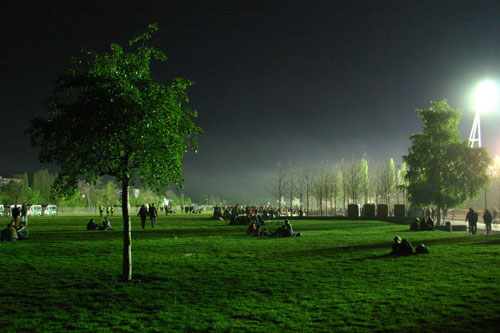
A lot of our time, especially the weekends, gets spent in Mauerpark, a big grassy space along the site of the former Wall. One of Berlin’s many talents is its ability to remake sites of terror and oppression into sites of celebration, even relaxation. Karl-Marx-Allee, 100 yards wide and lined with ceramic-tiled apartment blocks, was designed for May Day parades of DDR military might; today it hosts anti-Nazi demonstrations and beer festivals. Many of the massive Nazi flak towers around the city, too thick to destroy, have been incorporated into public parks as latter-day follies. Mauerpark is no different: The former death strip is now a stubbly field populated by—depending on when I visit—hawkers, buskers, drunks, picnickers, families, couples, cruisers, grillers, petty arsonists setting fire to trash cans, bocce players, rock bands, cyclists, skaters, graffiti artists, drug addicts, dealers, frotteurs, yuppies, retirees, and, for lack of a catch-all term, flaneurs.
On Sundays my wife and I lead friends through a labyrinthine flea market in the former French part of Mauerpark, where locals sell handicrafts and DDR flotsam amid piles of disused building materials and restaurants inside jerry-rigged lean-tos. Last weekend one of our charges got lost in the flea market and we spent an hour looking for him. The day was hot and dry, and after a while I took a break along a low stone wall. The ground around me was scattered with dead grass, dead campfires, and broken bottles, but the scene around me was anything but grim. People of all sorts, from toddlers to swillers, bumped elbows. A rock band set up their equipment behind me, unannounced and apparently unlicensed; within minutes a crowd gathered and an impromptu concert began. Lovers sprawled on the grass uninhibited by the pile of empty Sternburg bottles nearby. Svelte volleyballers played a few feet from punks building a bonfire.
For the first two decades of its post-wall life, Berlin could afford messy anarchism—there simply weren’t enough people to wish otherwise.There’s no closing time at Mauerpark, and people stay all night, though at their own risk. One morning I came to work and found the office chattering about a middle-aged couple that was attacked in Mauerpark late the previous night; the two assailants stabbed the man and ran north, toward Gleimstrasse. It would be an incident of passing note in many American cities, but here the story was on every paper’s front page. In part that’s because the attack justifies many bourgeois Berliners’ worst fears of Mauerpark, and in part because the future of Mauerpark itself has been much in the news lately. On a recent Tuesday night young partiers set up a bonfire of wood palettes; responding firemen found themselves under attack from some 150 people, tossing bottles. The next morning police say someone threw paving stones at four cars parked nearby. In both cases, and in many others, police have fingered far-left radicals as the culprits. After a string of late-night arson attacks against parked cars this year, police spokesmen have warned of an oncoming wave of leftwing violence; after the Mauerpark fire, the police president, Dieter Gleitsch, speculated that police and firemen may soon be unable to do their jobs in the face of frequent, and frequently violent, mobs.
Most Berliners I know—a generally liberal bunch and pretty typical for the city—tell me the police are playing up the leftists’ role, and they downplay conservative chatter about a coming wave of leftwing violence. But they don’t deny that the city is restless. Many Berliners in the central districts are unhappy over the city government’s support for commercial development, high-end condo construction, and everything else that falls under the rubric of gentrification. Berlin suffers from all the same problems faced by once-derelict, suddenly trendy cities worldwide: rising rents, capricious developers, rezoning. But unlike residents in, say, Portland, Ore., many Berliners place little faith in the legislative process. Direct action, at least for the young, is still a preferred form of social activism. Earlier this summer more than 1,000 protesters clashed with police outside the shuttered Tempelhof airfield; developers and allies in the government want to turn much of the 450 acres into mixed-use neighbourhoods, while local activists want it to be a new city park. And there are recurrent street fights over Mediaspree, a public-private effort to turn a stretch of riverbank southeast of the city center that is currently home to a bevy of artist collectives and dance clubs, into a home for IT, media, PR, and graphic design firms, with a heavy dollop of corporate entertainment on top—the newly opened hockey stadium, sponsored by the O2 cell phone company, was christened with a concert by Tina Turner.
This is Berlin, and everything carries an outsized significance.A similar story is unfolding at Mauerpark. There’s adjacent land to be had, but a real estate developer wants it for condos. The city wants it for park space, but it’s willing to split the land in half. That’s a compromise too far for some: They say the plan would ruin the symmetry of the park by developing much of the former western side of the wall, a symmetry critical to the historical meaning of the entire site. But they also worry that looming towers full of yuppies will wilt the anarchic spirit of the park itself; the new neighbors won’t easily tolerate garbage, loud noise, drunks, and the occasional stabbing.
It’s rare for such hyper-local politics to mean much beyond a few blocks, but this is Berlin, and everything carries an outsized significance. In this case, development is a crucial test for the city’s Social Democratic mayor, Klaus Wowereit. A Berlin journalist once told me that if the traditional SPD leadership were Detroit Democrats, then Wowereit—charismatic, metropolitan, openly gay—was a San Francisco liberal. He has aspirations to higher office; some speak of him taking over the left-leaning SPD should the party receive its predicted drubbing in next month’s national elections. This puts him in a tough place: To win national respect he has to show control over his city and its bottom-barrel economy. But he also knows that many sunny-day allies will turn on him if he seems to stray too far from his far-left bona fides. As a result he’s stuck between the right, which accuses him of coddling leftists, and the left, which accuses him of coddling condo developers.
But the bigger story is about Berlin itself. For the first two decades of its post-wall life, Berlin could afford messy anarchism—there simply weren’t enough people, at least people of consequence, to wish otherwise. No one wanted Mauerpark for anything other than open space, and if no one wanted to clean up Mauerpark either, well, most Berliners didn’t mind. But over time, Berlin has filled in; there’s still no industry in the city, but like any trendy neighborhood, the cheap rents attracted artists, who in turn attracted generally creative types, who in turn attracted developers, who in turn attracted yuppies willing to shell out top euro for the next edgy thing.
Berlin is still cheap, and it’s still relatively empty. But the apartment renovations up and down my street aren’t making way for more low-rent housing. In a decade, Gleimstrasse will look completely different; the neighborhood bar will be a fusion restaurant and the hole-in-the-wall grocer will be an all-organic shop. And whether or not the developers have their way, Mauerpark itself will come under pressure to change; it will be cleaned and patrolled, and the flea market will be turned into a museum of a bohemia the rest of the area left far behind. And the delicate, anarchic freedom that Mauerpark did so much to preserve, as a testament to the city’s violent and oppressive history, will itself be a thing of the past.
Anarchy is dying in Berlin, and Tina Turner swung the axe. Beginning a new series, our man in Germany reports from a park full of arsonists, punks, and frotteurs.