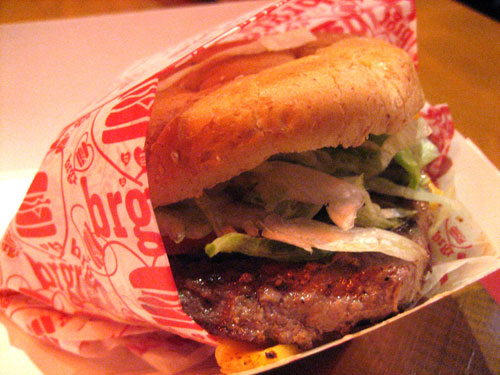
Last week, 143 million pounds of beef were recalled after the Humane Society released undercover footage of sick cows in the Westland/Hallmark Meat Packing Company in Chino, Calif., being kicked and forced to walk with forklifts and electric shocks. The meat from the “downed” cows was sent mostly to school lunch programs and other federal nutrition programs.
Throughout February, the media latched onto to the Westland/Hallmark beef recall story, giving journalists and editors everywhere an excuse to use the headline: “Where’s the Beef?” The answer, the public hoped, was “far, far away.”
After the initial recall on Feb. 17, it was up to the schools that had received Westland/Hallmark beef to dispose of it. On Feb. 20, it was reported that Ron Wyrick, superintendent of Sallisaw Public Schools, was working with the health department to decide how best to do this, since he “believes it wouldn’t be good on the school’s garbage disposal to shove down 300 pounds of meat.”
Schools in Spokane, Wash., came up with a slightly more reasonable solution for getting rid of 50,000 pounds of contaminated beef: Bury it six feet underground. According to Mike LaScuola, a technical advisor of environmental health for the Spokane Regional Health District, this is a surefire way to make sure the meat doesn’t get back into the market.
Oxford Central School cafeteria workers in New Jersey had the expertise and professionalism to spot and “put aside” Westland/Hallmark beef that was “odd-looking”—even before they’d learned of the recall. And in a Los Angeles Times article on Feb. 1, the California Department of Education had already gotten wind of the allegations against Westland/Hallmark, and urged school districts across the state to stop serving beef products.
At £100 a kilo, Wagyu is far pricier than Brazilian beef—but then you wouldn’t be eating “the Ferrari of meats.” Eventually, school cafeterias around the country were striking beef from their menus. Stanwood-Camano school districts in Snohomish County, Wash., were forced to “reconfigure menus to include protein sources such as cheese and ham pizza, turkey noodle bake, and chicken burgers.”
It wasn’t just school cafeterias that were affected. Beef export negotiations with Japan and South Korea—two markets that have refused to import U.S. beef because of a 2003 mad cow epidemic—were set back because of the recall. The negotiations were eventually worked out, however, and even resulted in an additional $1.7 billion of beef exports for the U.S.—a 17 percent increase from a year ago.
Even better news is that the recalled Westland/Hallmark beef hasn’t caused any reported illnesses and poses little risk to consumers. Not that anybody can buy the questionable beef now anyway: Some is as much as two years old, and most has been eaten up by now.
For all the attention the recall received, nobody is talking about the four herds of Minnesota cattle that have tested positive for TB since 2007 or the beef contaminated with listeria that was served this month in hospitals and cafes in New Zealand.
In related news, this month DuPont announced it was working to develop a faster E. coli test—results can come back in as little as 30 minutes.
Earlier this month, the European Union accused Brazil of exporting un-inspected beef and placed a ban on Brazilian beef imports. Some say the measure was meant to “prevent Brazil from gaining access to markets”; others claim its origin is based on “serious and well- founded concerns about animal health and hygiene standards in Brazil.” The economic result, however, is clear: Of the 2,681 farms Brazil claims as eligible to export beef, the E.U. will accept meat from only 523.
Europeans need not worry. This month, we also learned that Italy and the U.K. are on the cusp of offering locally raised Wagyu beef to local carnivores. At £100 a kilo, it’s far pricier than Brazilian beef—which costs about a dollar a pound to produce—but then you wouldn’t be eating “the Ferrari of meats.”
Amidst all this controversy, the Beef Innovations Group (B.I.G.) introduced “five bright, new stars among their team of new beef cuts as a result of extensive chuck roll optimization efforts.” The new cuts are part of its “Long Range Plan to increase beef demand by another 10 percent by 2010.” B.I.G. shouldn’t have much trouble meeting its goals as long as the owners of Mallie’s Sports Grill & Bar keep selling the 134-pound hamburger that broke the Guinness World Record on Feb. 24.
Despite the beef-related cheer, the Tyson Foods plant in Emporia, Kan., laid off more than 200 workers this month; many were offered positions at Tyson’s poultry plants. Perhaps the openings were due to news this month that Tyson recently fired workers “embroiled in chicken torture.”
Arguably, the workers weren’t keeping chickens as pets—it was reported this month that, in addition to helping fight off dementia, pet chickens lower blood pressure. Though it’s difficult to say what the motive is of the dogs on the island of Guernsey, who constantly kill chickens.